nandhivarman லேபிளுடன் இடுகைகளைக் காண்பிக்கிறது. அனைத்து இடுகைகளையும் காண்பி

செவ்வாய், 23 அக்டோபர், 2018

பிரான்சு அரசே குற்றவாளியென தூக்கில் போட்ட கொடியவன் பெயரில் இன்னமுமா புதுவையில் வீதி ?


அருகன்மேடு நாகரிகத்தை மறைக்கப் பார்க்கும் தொல்லியல் துறை


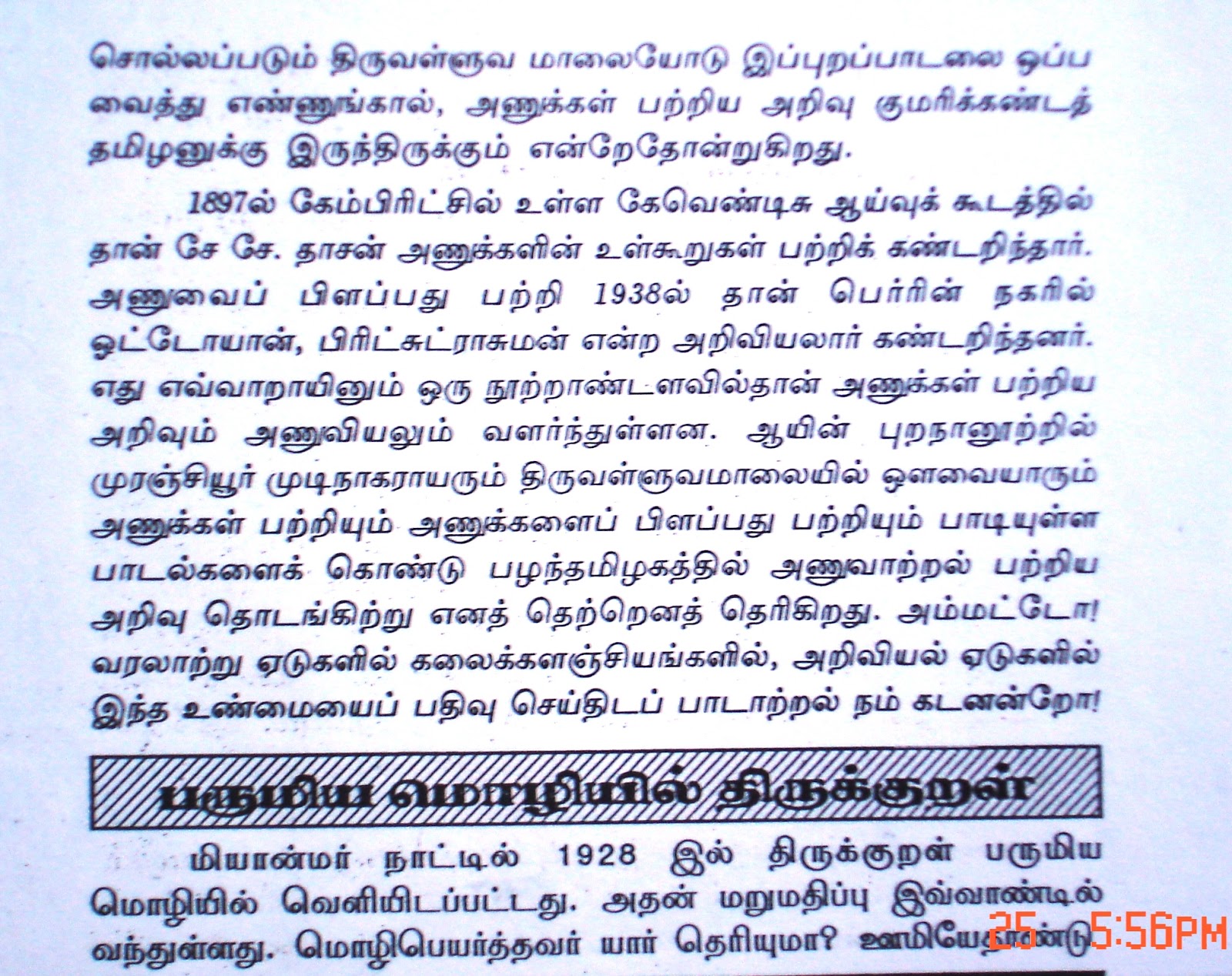
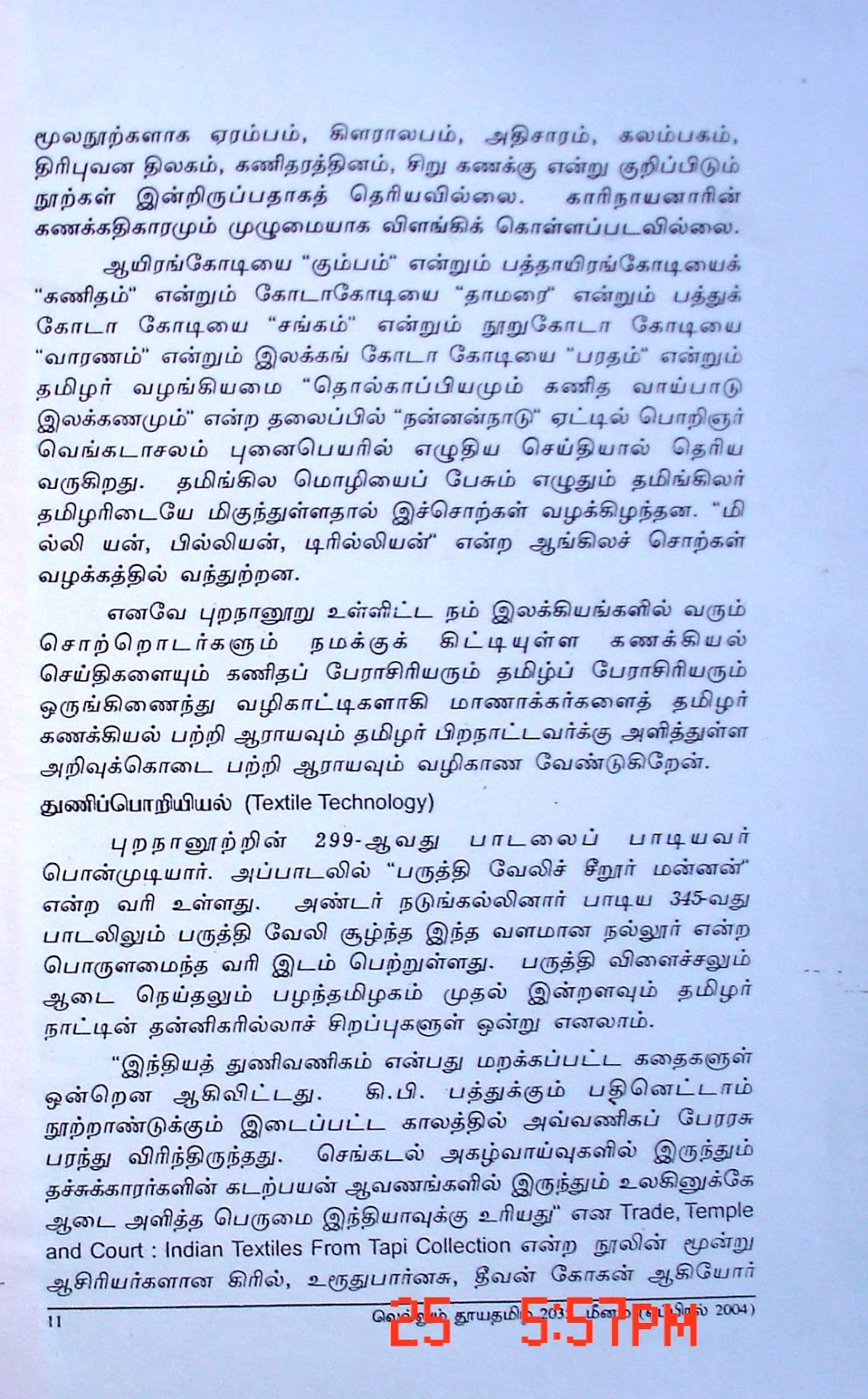
புதுவை மொழியியல் பண்பாட்டு ஆராய்ச்சி நிறுவனக் கருத்தரங்கில் புறநானூற்றில் அறிவியல் நந்திவர்மன் உரையை வெளியிட்ட வெல்லும் தூய தமிழ்


ON MY BOOK HISTORICAL IMPRINTS OF PUDUCHERRY LATE DR.A.ARIVUNAMBI


LATE DR.A.ARIVUNAMBI ACTING VICE CHANCELLOR OF PONDICHERRY UNIVERSITY IS MY FOREVER FRIEND


LANGUAGE LABOUR

N.Nandhivarman

  Pondicherry University, a Central University established the Department of Tamil in 1986, and later upgraded to a School of Tamil. Yes, thus came the Subramania Bharathi School of Tamil Language and Literature. “This school had produced 60 scholars who have done their PhD’s and 28 are currently striving to become Doctors of Literature. 181 scholars obtained M.Phil degrees and currently 34 are studying. The research culminates in presentation of scholarly thesis” states Dean of the School Dr. A.Arivunambi. Dr.Arivunambi also functions as Acting Vice Chancellor during the absence of the regular Vice Chancellor. As the leading beacon of Tamil Development he states with pride that Pondicherry University is the first and only one to have got grants for 5 years under Special Assistance Scheme from the University Grants Commission. This recent achievement gives impetus to draw plans for the development of Classical Tamil.

“If you want to know about the Tamil computing researchers, www. tamilsoftware.biz lists out only 2 people from the Union territory of Pondicherry. They are Professor Kuppusamy, who heads the Computer Sciences Department of Pondicherry University and Prasanna Venkatesan, Lecturer of same faculty. At one faculty two researchers exist to give impetus for promoting Tamil in the world of web, and the other side we have a Tamil Department which had yet to avail this talent within the campus to equip Tamil scholars and students with adequate knowledge to handle computers and to elevate Tamil to the reach of netizens.” opined a Tamil scholar with anguish. There seems to be fresh plans for inter departmental coordination after such criticisms were aired in scholarly circles. 

The western experiments to open knowledge to one and all by creating Open Access Online Libraries, from where all scholarly research papers could be availed by anyone interested from any part of the globe is slowly spreading its influence over Tamil scholars. Tamil lovers of Pondicherry are keen to know the subjects of the research undertaken by various scholars in the Pondichery University. “The practice to upload all research materials into Internet is a must and web publishing must be given top priority so that what a researcher in Pondicherry University does becomes known to other researchers all over the world,” said C.P.Thirunavukkarasu, President of Anna Foundation. Though members of the faculty have brought out many books and students too have many books and articles to their credit, in these days of globalization, they have to market their achievements, publicize them and bring it to public notice.

 A report of the expert committee headed by Va.Suba.Maniccam Former Vice Chancellor of Madurai Kamaraj University had in the initial years suggested for creation of separate faculties for Tamil Studies, Linguistic Studies, Fine Arts and Overseas studies. It had mooted the suggestion that under the faculty of Tamil Studies departments of Tamil Literature, Cultural studies, Religious and Mythological Studies, Comparative literature and Indian folklore could be set up. The committee also had suggested separate department for Bharathiar and Bharathidasan Studies.

The Faculty of Linguistic Studies with separate departments of Indian Grammatical Studies, Linguistics, Translation, Dialectology and Tribal languages and The Faculty of Fine Arts with Department of Music, dance, Drama and Painting must have been set up, if the recommendations of the expert committee had been taken into consideration. Much time is lost and because these faculties and departments were not created in spite of the First Central university being started in a Tamil language speaking region.

Dr.R.Kothandaraman of Tholkaapiyar Centre for Fundamental Research says that “sixteen years had passed and lots of opportunities are lost. There is a need to review the expert committee’s suggestions and to have an update on its recommendations so that fresh initiatives to develop Tamil studies could be explored”. Incidentally he was one of the members of that Expert committee. Due to non allocation of funds where our representatives failed, all such new departments could not come up till 2007, the time when next five year plan launches. As a prelude for opening Departments of Modern Literature and Religious Literature, two new M.Phil courses have started, thanks to the initiatives of Dr.Ilamathi Janakiraman. 

This unique Central University must be made into a global meeting place for promoting Tamil as an international language with state-of-the-art technology to connect to the global Tamil community via the Information Highway feel the foreign scholars doing research in Tamil.

 “To help Tamil communities living abroad to establish a digital network for promoting the study of Tamil language and literature, to establish a grid of learning so that Tamil communities worldwide may exchange Web-based resources, to develop and promote Tamil in electronic form to enable Tamil learners to experience the glory of Tamil language and culture, to promote a sense of Tamil identity both in nations having large Tamil populations and all former French colonies with which still sizeable Pondicherrians are culturally and professionally interlinked, Pondicherry University had lot to do” opines Mannar Mannan, President of Puthuvai Tamil Sangam.

“These former French colonies have large population of Tamils who are on the verge of forgetting their mother tongues. Hence online courses to impart Tamil learning to geographically separate Tamil communities becomes the historical mission of Pondicherry University and it is time it reaches out to those who need its help” said Professor M.Lenin Thangappa.

 But all scholars are hoping that Subramania Bharathiar School of Tamil studies will surge ahead and scale great heights in glory, since the very name of the school will be a source of inspiration for all knowledgeable Tamils to pool their goodwill to make this School known internationally.

Courtesy: New Indian Express-weekend: 7.05 2005


TO FACE NATURAL DISASTERS LOG IN TO NET AND BE ALERT


LOG IN, TO BE PREPARED
               
N.Nandhivarman

The internet provides a lot of information about natural disasters, and can help people in being forearmed. For that is being forearmed.

Time has come for including disasters management as part of our school curriculum. As disasters have become common, the news coverage is more on the plight of the victims but the thrust area of scientific protections and preparedness in hazards management are ignored.

In one way this could be explained. The question of who will bell the cat is a major stumbling block for predictions. If a scientist forewarns, immediately there are people to counter his views. Instead of expecting government agencies to wake up on time, people must be prepared to rise to the occasion with help of the media. In this field, various earthquake observatories of United States Geological Survey and that of many universities provide information, easily accessible to every one via internet.

Now we can have just observed International Day for Natural Disaster Reduction on OCTOBER 13 while we are surrounded by disasters. United Nations designated the second Wednesday of October every year from December 22, 1989 as International Day for Natural Disaster Reduction and called it as a vehicle to promote a global culture of natural disaster reduction, including disaster prevention, mitigation and preparedness.

EXPLANATION

_ Divergent plate boundaries- where now crust is generated as the plates pull away from each other.

-Convergent   plate boundaries- where crust is consumed in the Earth’s interior as one plate dives under another.

-Transform plate boundaries- where crust is neither produced nor destroyed as plate’s side horizontally past each other.

-Plate boundary zones- Broad belts in which deformation is diffuse and boundaries are not well defined.
                               
Selected prominent hotspots

In pursuance of this, we have to evaluate various measures suggested by United Nations, scientific observatories, various countries and their experiences to evolve right methods for facing natural hazards. It is here the lessons and play tools crafted by the United States Geological survey assume significance. They not only educate people about current earthquakes through animation pictures taken from observatories but also prepare them to be mentally prepared to face calamities.

What we now witness is quakes along the collision lines of continental plates. Exactly what drives plate tectonics is not known. One theory’s that convection within the Earth’s mantle pushes the plates, in much the same way that air heated by your body rises upward and is defected sideways when it reaches the ceiling. Another theory is that gravity is pulling the older, colder, and thus heavier, ocean floor with more force than the newer, lighter sea floor. Whatever drives the movement, plate tectonic activity takes place at four types of boundaries; divergent boundaries, where new crust is formed; convergent boundaries, where crust is consumed; collision boundaries, Where two land masses collide; and transform boundaries, where two plate slide against each other, according to the site www.enchantedlearning.com.

Another truth that researchers are revealing is that the Earth’s longest mountain chain is not the Andes in South America, or the Himalayas in Asia, or even North America’s Rockies. It’s an underwater chain of mountain s 47,000 miles long.

The Chain runs down the middle of the Atlantic Ocean [surfacing at Iceland]. AROUND Africa, through the Indian Ocean, between Australia and Antarctica, and north through the Pacific Ocean, Running along the top of this chain of mountains is a deep crack, called a rift valley. It is here that new ocean floor is continuously created. As the two sides of the mountain move quay from each other, magma swells up from the Earth’s interior. It then solidifies into rock as it is cooled by the sea, creating new ocean floor.

The speed at which new ocean floor is created varies from one location on the ocean ride to another. Between North America and Europe. The rate is about 2.2 inches [(3.6) per year. At the East Pacific rise, which is pushing a plate into the west coast of South America, the rate is 12.6 inches (32.2) per year. With detailed mapping of the ocean floor came many observations that led scientists like Howard Hess and R DEIZAto call the new theory as ‘Sea floor Spreading.’

Among the features that supported the sea-floor spreading hypothesis were mid oceanic ridges. deep sea trenches, island arcs, geomagnetic patterns, and fault patterns. “The deepest waters are found in oceanic trenches, which plunge as deep as oceanic trenches, which plague as deep as 35,000 feet below the ocean surface. These trenches are usually long and narrow, and run parallel to and near the oceans margins. They are often parallel to large continental mountain ranges. Like the mid-oceanic ridges, and that the age of the ocean floor increased in addition, it has been determined that the oldest seafloor often ends in the deep-sea trenches.”

The Western Pacific margin has islands such as the Aleutians, Knurliest, Japan, Ruckus, Philippines, Marianas, Indonesia, Solomon’s, New Hebrides, and the Tonga’s, which can be best described as ‘Island arcs’ and usually situated along deep sea trenches situated on the continental side of the trench. All these and many more new findings which could be read from various web sides provide A to Z information on all natural phenomena along with projections for natural disasters ahead.

On hearing news about natural disasters, students could log onto these web sites and find relevant information to forewarn the people. For instance it must be noted that on the day of Pakistan and Kashmir Quake, there were 177 quakes all over the world., They may be low on the Richter scale, but earth is uneasy and if the quake is in the boundary of Indo-Australian plate as in the recent case one can forewarn the route it may take in due course of time’s


Courtesy: New Indian Express: 15th October 2005


LYSEE FRANCAISE PROFESSOR OF TAMIL MADANAKALYANI SHANMUGANANDAN


CHEVALIER MADANAKALYANI   

 Nandhivarman

The French Government  had conferred the prestigious title Chevalier dans L’Ordre des Palmes Acade’miques on Madanakalyani Shanmuganandan who recently retired after 41 years of service as Professor of Tamil in the French College called Lysee Francaise. She has a lengthy list of publications to her credit on a variety of subjects, but she is hailed particularly for her translations.

Translating without losing the essence of what said in the original language is a risky adventure. Our first President of India, Dr Rajendira Prasad, was to lay the foundation stone for the office of the Comptroller and Auditor General. For that function the confusion created by translation is written in the book The Constitution and Language Politics of India by Wing Commander BVR Rao. The book narrates the incident thus;

“The authorities got a Hindi translation from All India Radio Hindi expert. Since President Prasad was to lay the foundation stone, they wanted to be sure of the correctness of the translation. They asked the Government of India Hindi expert to give a translation and they found it to be different from what was given by the AIR Hindi expert. The officials concerned were worried since they did not want the President, himself a Hindi expert, to criticize them for a wrong translation and therefore decided to request the President himself to give the translation. When the officials received it, it was different from what was given by the other two Hindi experts.”

If translation could cause so much confusion, one must understand the difficulties encountered by translating poetry from Tamil to French and classics from French to Tamil. In that difficult task Madanakalyani had scored, winning the prestigious Chevalier award, which speaks about her efficiency.

For instance the French college had brought out a beautiful book translated from French to Tamil by Madanakalyani. Puthucheri: Oruvanigathala oorin varalaaru (History of Pondicherry a Mercantile city]

It is a remarkable book and its value is not being understood in the Library circles of Pondicherry. “Only 27 copies of this monumental treatise have been bought.” Madana kalyani says with anguish. If a noteworthy publication on Pondicherry has no takers, it means, while the whole world is moving to watch History channels, among Pondicherrians the interest in history is on the wane. She had translated the Tamil folk songs of Pondicherry into French, a few of which had been chosen and included among the meritorious poems in French in the year 1998.

The book Britannicus by French dramatist Racine was translated into Tamil in 1974, titled as Veezhchi. At the same time, Madana kalyani is to translate Tamil works into French, out of abundant love for her mother tongue. The folk stories in circulation in and around Pondicherry were translated into French and printed in France titled Contes de Pondiche’ry. That book carried the Tamil version of the folk songs too. Her remarkable popularity, we can mention with certainly is due to her translation of La Peste written by the Nobel Laureate Albert Camus.

She had translated Bharathiar’s poems in 1982 under the patronage of the Government of Pondicherry. In 1988 she contributed to the translation of Siruthondar Puranam. Continuing her efforts, by 1999 she had also been involved in translating Sakkier Puranam. The stories of Vikramadithiya, Indian folk stories and Bharathidasan’ poems were also rendered into French.

She had brought into Tamil the Stories of Statues in Pondicherry, the poems of Poet Baudelaire, Victor Hugo, La Fontaine, Apollinaire and Rimbaud. She also wrote a series in a local Tamil daily for 80 days about simplified ways to learn French.

Prema Nandakumar, in her commentary on the Tamil translation of Nobel Laurette Albert Camus, says, “Let not Tamil lament over their failure to get the Nobel Prize. Even if few books are written how it should be deeply written without deviating from pragmatism, and how effectively it could illuminate the inner streams of human thought must be learnt by reading the work of Albert Camus. Madanakalyani with responsibility had done a great service.”

Such tribute to her translation places Madanakalyani one among the top literary scholars of Pondicherry. She is also the joint Secretary of Puthuvai Tamil Sangam, having assisted its activities for too long a period. The title Chevalier conferred on Shivaji Ganesan made it as popular as Padma Bhushan.”

In Pondicherry there lives humble woman Chavalier who had not caught the due attention of feminist writers and media. It is high time that the women litterateurs of Tamil Nadu give due recognition for Madanakalyani,” says Tamil research scholar in charge of Bharathiar Museum Dr N Sengamala Thayer. Let us hail the free flow of French. Tamil literary exchanges made possible by Madanakalyani.              
 Courtesy: New Indian Express: 6th November 2004